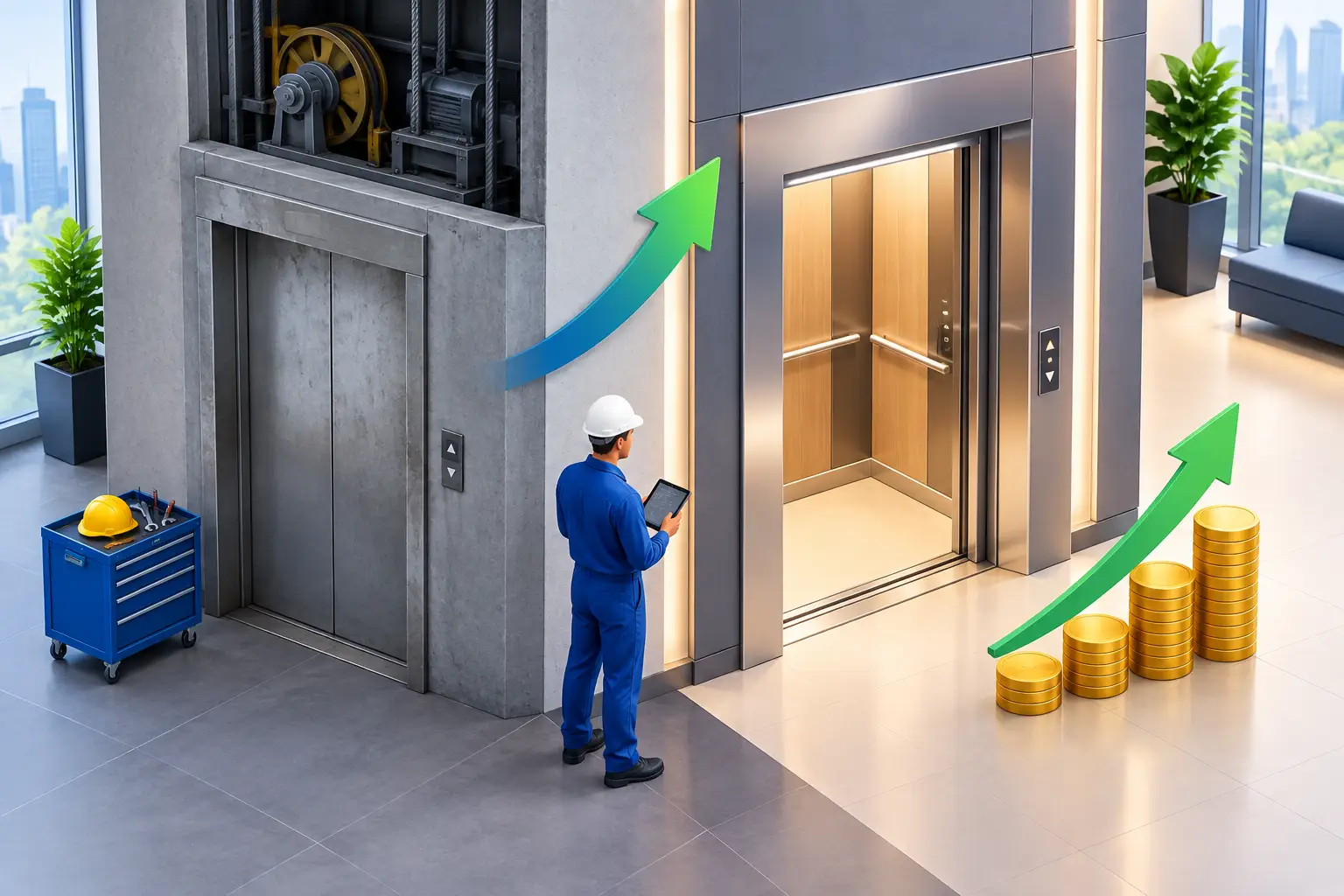
A lift that still travels between floors is not necessarily serving the building well. Repeated call-outs, slow door operation, passenger complaints and hard-to-source parts can all signal that lift modernisation services are becoming a practical operational need rather than a future consideration. For property stakeholders, the right decision is rarely about replacing everything at once. It is about understanding which components are limiting safety, reliability and tenant experience, then improving them in a planned, controlled way.
For commercial buildings, hotels, malls, residential developments and industrial sites across Botswana, lift performance affects far more than convenience. It influences accessibility, visitor confidence, staff productivity and the ability to keep daily operations moving. Modernisation can extend the useful life of an existing installation while bringing critical systems closer to current safety, performance and communication expectations.
What lift modernisation services involve
Modernisation is the targeted upgrade of an existing lift system. It sits between routine maintenance and full replacement. Rather than removing a complete installation, a specialist assesses the condition of the equipment and recommends upgrades to the components that have the greatest impact on operation, safety and future serviceability.
The scope may be modest, such as replacing an ageing controller or upgrading the car operating panel. It may also involve a wider programme covering doors, drive systems, wiring, landing fixtures, communication equipment and cabin finishes. The best approach depends on the lift’s age, usage pattern, maintenance history, available parts and role within the building.
A busy hotel passenger lift, for example, faces different pressures from a goods lift in an industrial facility. A residential block may prioritise dependable door operation and emergency communication, while a premium office development may also require a more contemporary interior and improved traffic handling at peak times. A proper assessment should account for these differences instead of applying a standard package to every site.
The signs that modernisation should be considered
A lift does not need to be completely out of service before a modernisation plan is justified. In fact, waiting for total failure can create avoidable disruption, urgent costs and pressure on building occupants. The clearer warning signs usually appear over time.
Frequent breakdowns are one of the most obvious indicators. When the same faults return despite appropriate repairs, the issue may be linked to ageing technology or worn components rather than an isolated defect. Rising call-out frequency also places greater strain on maintenance budgets and can leave tenants questioning whether building services are being managed proactively.
Parts availability matters just as much. Older controllers, relays, door operators and electronic boards can become difficult or expensive to obtain. If replacements are obsolete, sourced only through uncertain channels or take too long to arrive, a minor failure can turn into extended downtime. Modernising key systems gives property managers access to components that can be supported more reliably.
Passenger experience is another valid reason to act. Noisy travel, levelling inaccuracies, slow responses, poor lighting, damaged finishes or unreliable doors can undermine perceptions of a building even where the lift remains operational. In hospitality, retail and high-profile commercial environments, these details are especially visible. Interior enhancement can be included in a modernisation project, but cosmetic work should never distract from essential technical and safety priorities.
Where the greatest improvements are often made
Controllers and drive systems
The controller is the operational centre of the lift. Older controllers can be difficult to diagnose, may offer limited fault information and can rely on components that are no longer readily available. A modern controller can improve monitoring, fault diagnosis and serviceability, helping technicians identify issues faster and reduce the likelihood of prolonged outages.
Drive upgrades may also improve ride quality and energy use, depending on the existing installation. However, savings should be assessed realistically. The main case for upgrading a drive is often improved reliability, smoother operation and supportability, with energy efficiency as an additional benefit rather than the sole reason for investment.
Doors and landing equipment
Lift doors are among the most heavily used and frequently fault-prone parts of a system. They are exposed to constant opening cycles, misalignment, physical impact and contamination. Slow or erratic door operation can cause delays, nuisance shutdowns and safety concerns.
Modernising door operators, rollers, sensors and landing equipment can make a significant difference to availability. This is particularly relevant in malls, hotels, hospitals and office buildings where heavy passenger traffic puts doors under continuous demand. The work must be carefully matched to the existing installation so that new equipment integrates correctly and can be maintained effectively over the long term.
Safety and communication systems
Safety systems deserve close attention during any lift modernisation review. Emergency alarms, car communication devices, levelling accuracy, door protection and electrical safety devices should all be inspected as part of the condition assessment. A lift may look acceptable to passengers while carrying hidden risks in systems they never see.
GSM communication units can provide a more dependable route for emergency calls where older telephone arrangements are no longer suitable. For building managers, this helps support a clear response process when passengers require assistance. The value is not merely technical compliance - it is confidence that an emergency call can be raised without delay.
How to plan a modernisation project without unnecessary disruption
The most successful projects begin with a detailed site assessment. This should examine the lift’s age, equipment condition, fault records, maintenance costs, usage level and current risks. It should also establish the building’s operational requirements: when the lift is busiest, whether there is another lift available, which users depend on accessible travel and what access restrictions apply.
From there, the scope can be prioritised. Critical safety and reliability upgrades should come first. Aesthetic changes, such as new flooring, wall panels, handrails, mirrors or lighting, can be scheduled alongside technical works where appropriate. Combining work can reduce repeated shutdowns, although it can also increase the length of a single planned outage. The right balance depends on how much redundancy the building has.
Communication with occupants is essential. Tenants, staff, residents and visitors need clear notice of when equipment will be unavailable, how long the work is expected to take and what alternative arrangements are in place. For a building with one lift, phased work or carefully timed out-of-hours activity may be preferable. For a multi-lift site, modernisation can often be planned one unit at a time to retain some vertical transport capacity.
A credible proposal should set out the equipment being upgraded, the reasons for the recommendation, expected operational benefits, programme implications and the support available after completion. The lowest initial price is not always the best value if it introduces unsupported parts, uncertain workmanship or weak aftercare.
Modernisation versus replacement
Modernisation is often the sensible choice when the lift structure, guide rails, machine room arrangement and core mechanical elements remain in serviceable condition. It can improve performance at a lower cost and with less building disruption than full replacement. It is also a useful way to bring an older installation forward in stages, spreading investment across planned budget cycles.
There are situations where replacement deserves serious consideration. Extensive structural deterioration, recurring major mechanical failures, unsuitable capacity or a system that cannot be brought to an acceptable standard through component upgrades may make replacement more appropriate. A transparent technical assessment should explain this clearly, including the risks of continuing to repair ageing equipment.
For many properties, the answer is neither an immediate full replacement nor endless reactive repairs. It is a defined modernisation programme that addresses the equipment most likely to cause downtime and safety concerns first.
Choosing a service partner for the long term
Modernisation should not be treated as a once-off installation exercise. The quality of commissioning, follow-up inspections, preventative maintenance and emergency response will determine whether the investment delivers its expected value. Property teams should look for a provider that can diagnose existing systems carefully, source quality components, carry out skilled installation work and support the equipment after handover.
Brand Matrix approaches modernisation as part of the full lift lifecycle, combining technical assessment with preventative maintenance, repairs, spare-parts support and responsive assistance when urgent faults occur. This joined-up approach helps building owners avoid the gap that can arise when one contractor installs equipment and another inherits it without proper documentation or familiarity.
A well-planned modernisation does more than refresh an ageing lift. It gives building managers greater control over risk, cost and downtime, while providing passengers with the dependable journey they expect every time the doors open.