
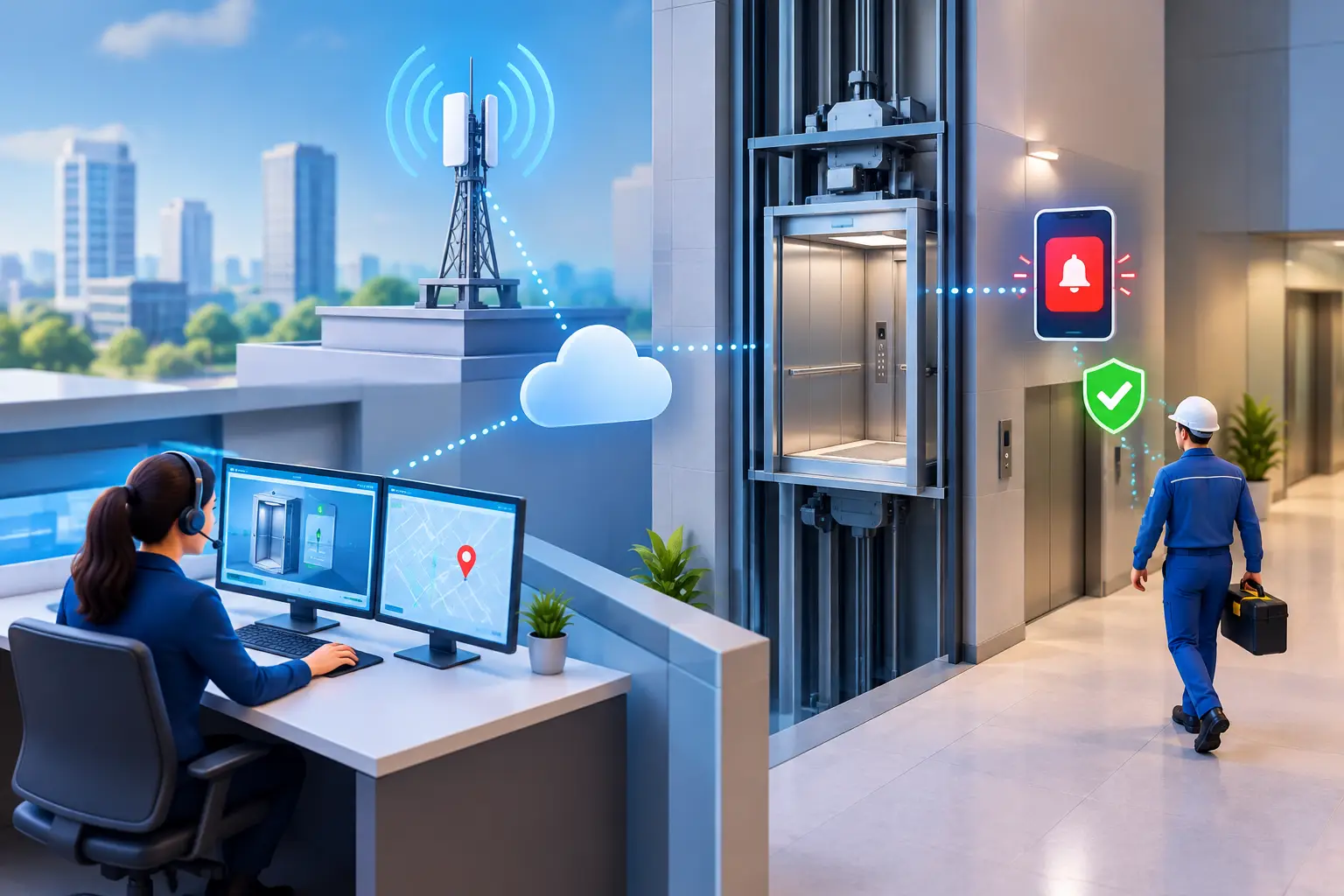
A lift can appear to be operating normally at 08:00 and become a tenant, guest or customer complaint by lunchtime. For property teams managing busy buildings, GSM lift monitoring provides earlier visibility of developing faults, controller alarms and communication issues before they become prolonged disruption. It gives service teams useful information sooner, so the response can be better prepared and more focused.
For hotels, malls, office blocks, residential developments and industrial sites, this matters because a lift outage is rarely just a technical matter. It affects accessibility, tenant confidence, visitor flow, staff productivity and, in some settings, safety planning. Remote monitoring cannot prevent every failure, but it can reduce the time between an issue occurring and the right action being taken.
What GSM lift monitoring does
GSM lift monitoring uses a mobile network connection to communicate selected information from a lift controller to an authorised service provider or monitoring platform. Depending on the controller, installed unit and site configuration, the system can report lift status, fault codes, door events, power conditions, emergency calls and repeated shutdowns.
Instead of relying solely on a passenger reporting that a lift has stopped, a monitored system can send an alert when the controller records a fault. This gives technicians a starting point before they arrive on site. If the alarm indicates a recurring door-zone error, for example, the technician can assess likely causes and bring appropriate tools or components where practical.
The value is not simply that an alert is sent. The value lies in converting the alert into a disciplined service response: checking the fault history, confirming the severity, contacting the site when needed, and dispatching a suitably equipped technician. A GSM unit is therefore most effective when it supports a clear maintenance and emergency call-out process.
Why faster information improves lift uptime
Every minute spent identifying a fault is a minute added to recovery time. When a technician receives only a report that the lift is “not working”, they may need to begin diagnosis from the first inspection. That is sometimes unavoidable, particularly with mechanical failures, but remote information can narrow the possibilities.
A history of recent controller events can also reveal patterns that are easy to miss during isolated call-outs. A lift that returns to service after a reset but repeatedly records the same door-lock alarm needs more than a reset. It needs investigation of the underlying condition, whether that involves alignment, contacts, rollers, wiring, door operator settings or another related component.
For a building manager, this supports more informed decisions. Repeated faults can be discussed with evidence rather than relying on anecdotal reports from occupants. It also helps distinguish between a one-off interruption and a trend that may justify planned repairs, replacement parts or modernisation work.
Early alerts are not the same as remote repair
GSM lift monitoring can assist diagnosis, but it does not make a lift maintenance-free and it cannot safely resolve every fault remotely. Lifts contain safety circuits, moving equipment and systems that require physical inspection, testing and adjustment by competent personnel.
A technician may be able to review controller data or perform approved remote actions on certain compatible systems. However, a trapped passenger call, a safety circuit fault, unusual noises, damaged doors or an uncertain operating condition still requires an urgent site response. Monitoring should strengthen safe maintenance practice, never replace it.
The operational benefits for property teams
The strongest case for GSM monitoring is practical. It helps property stakeholders move from reacting only after complaints to managing lift performance with more timely information.
For a hotel, an alert outside normal operating hours can support a quicker response before morning guest traffic begins. In a shopping centre, monitoring can help the facilities team understand whether an interruption is isolated to one lift or affecting a wider system. At a residential development, it can provide reassurance that faults are being identified and acted on promptly, especially where residents depend on lifts for daily access.
There are also maintenance-planning benefits. Fault records can help a service provider prioritise recurring issues, identify components approaching the end of their useful life and recommend work at a suitable time. This may reduce avoidable emergency call-outs, although the result depends on the age, condition and usage of the equipment.
For older installations, GSM monitoring often delivers particularly useful insight because intermittent faults can be difficult to reproduce during a scheduled visit. It does not remove the need for modernisation where equipment is obsolete or unreliable, but it can provide useful evidence for the investment decision.
What information should be monitored?
The right configuration depends on the lift controller, building risk profile and the service arrangement. Property managers do not need to interpret every technical code themselves. They do, however, need agreement on what is monitored, who receives notifications and what happens after an alert.
A sensible arrangement normally focuses on events that affect passenger safety, availability or repeated performance concerns. These can include out-of-service conditions, controller faults, loss of mains power, battery or emergency communication concerns, door faults and frequent resets. The service provider should explain which notifications require immediate attendance and which should be reviewed during planned maintenance.
Too many low-priority alerts can create noise and lead to alerts being overlooked. Too few may leave the team unaware of an emerging fault. The aim is useful, relevant reporting rather than a stream of technical messages with no clear action attached.
Emergency communication remains essential
GSM connectivity can also support lift emergency communication, subject to the equipment design and applicable requirements. This is particularly relevant as older telephone-based arrangements may be unreliable or unsuitable where fixed lines are not available.
Emergency communication should be tested routinely, not assumed to work because a GSM unit has been installed. Signal strength, SIM status, power backup, handset function and call routing all need verification. A unit that can transmit controller data but cannot complete an emergency call is not an acceptable outcome.
Site factors that affect performance in Botswana
Mobile connectivity is central to GSM lift monitoring, so signal quality inside the lift shaft and machine space must be assessed. Thick concrete, below-ground locations, metal structures and distance from the nearest network coverage can all affect performance. In some buildings, an external antenna or another approved installation solution may be needed.
Power quality also matters. Voltage fluctuations, outages and inadequate backup arrangements can influence both lift operation and communication equipment. A proper assessment should consider how the GSM unit behaves during a power interruption and whether it continues to support emergency communication for the required period.
The monitoring installation should be neat, protected and documented. Unauthorised wiring changes, poorly fitted antennas or unsupported controller connections can create faults rather than solve them. Work should be completed by technicians who understand both the lift control system and the communication equipment being added.
Questions to ask before installing a GSM unit
Before approving GSM lift monitoring, ask how the unit is compatible with the existing controller and what events it can actually report. Clarify whether the system provides alarm notifications only, remote diagnostics, emergency call capability or a combination of these functions.
It is also worth confirming who monitors alerts after hours, the expected response process, the cost of SIM connectivity and whether there are recurring platform charges. Ask how fault records will be used during maintenance reviews and whether your site team will receive clear, non-technical updates when significant issues occur.
Finally, establish the boundary between monitoring and maintenance. A GSM unit is a valuable tool, but lift reliability still depends on regular inspections, correct lubrication, adjustments, safety testing, quality replacement parts and timely repairs. Brand Matrix approaches monitoring as part of that wider lifecycle responsibility, with the goal of keeping people-moving systems safe, available and properly maintained.
The most useful monitoring system is the one that gives your building team clearer warning, your service provider better diagnostic information and your passengers fewer reasons to notice the lift at all.